
By Martin Luttrell
Town officials got their first up-close look at the Muddy Brook North Conservation Area over the weekend and shared some thoughts on how the 24.2-acre parcel can be used for hiking, wildlife viewing and other passive recreation.
Conservation Agent Isabella Genova led members of the Conservation Commission, Select Board and Metacomet Land Trust, along with a few town residents, on a tour of the land on Saturday morning. The parcel, situated on the westerly side of Route 16 and bordered to the south by North Avenue, is mostly wooded with 2,400 feet of frontage on Muddy Brook.
The town purchased the parcel in 2004 using Community Preservation Act funds.
Genova said plans for the land include an out-and-back trail with a footbridge spanning the brook, benches and a pollinator garden in one of site’s open fields.
“This trail is pretty exciting because you get to walk through different habitats … open agricultural fields, wooded areas and forested wetlands,” she said.
The guided walk began in the field across North Avenue from the Clough School, in what once was an apple orchard, going through a wooded area and into another field that could serve as a pollinator garden — a specialized landscape designed with native, nectar-rich plants to support bees, butterflies, moths and hummingbirds.

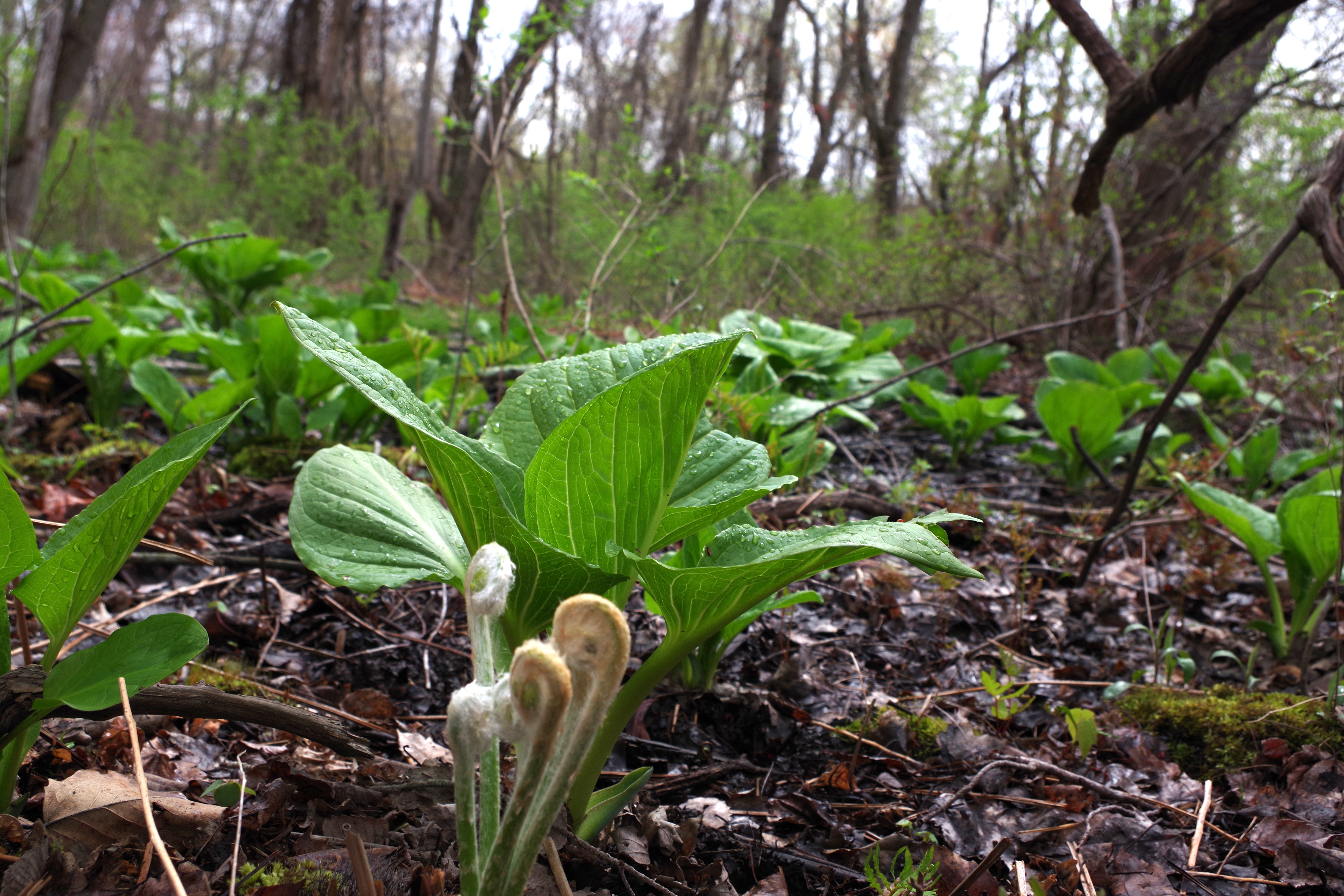
From there the tour proceeded into a larger woodland with a descending slope, past a collection of cast-off household items including a bathtub, refrigerator and several large metal items, in addition to a rusting car from the early 20th century. As the makeshift trail, marked with surveyor tags, neared Muddy Brook, the forest floor intermingled with soft wet earth thick with emerging fiddleheads and skunk cabbage.
Despite its name, the brook ran clear and cold, meandering through a forest of mixed hardwoods and pines, highbush blueberry and a variety of shrubs.
Conservation Commission member Terrence Moore suggested at the start of the tour that participants identify visitor-use opportunities, signs of wildlife habitat, and evidence of animal or vegetation species of concern that should be safeguarded from human intrusion.
He suggested thinking about broad concepts or themes about the site that could be imparted to visitors as locations for the trail, bridge and benches are identified. He said that visitors might see the parcel as a valuable remaining ecosystem in a changing rural to suburban region; that historically, Muddy Brook has been a place of human occupation and resource use, and is facing threats from regional and global environmental challenges.
Select Board Chair Jason Kuter was optimistic about the opportunity to make the conservation area available to a lot of people. Among his observations were that the land witnesses time through constant reinvention: Today’s trails were yesterday’s orchards, and before that, colonial pastures and Nipmuc homes.
“Even as we work to restore these spaces, the artifacts of human presence remain,” he said. “Highlighting this tension between restoration and legacy offers a fascinating perspective on our place in the timeline.”
Metacomet Land Trust Vice President Russ Holden commented that the parcel might be an example of “neighborhood ecology.” He cited the history of human use of the land — the former apple orchard and dumping ground for large appliances — along with more current activity nearby: the solar farm, a storage facility, an elementary school and a former gas station whose leaky fuel tanks contributed some amount of arsenic residue.
“Meanwhile, the parcel we actually walked consists of ecologically valuable elements such as a stream, wetlands and woods. Many of these land uses and human interactions are common in an urban setting, but this parcel isn’t really urban. So, I think this parcel is a local ecological treasure amidst numerous ‘neighborhood’ challenges and priorities.”
Going forward, Genova said the town will post requests for proposals for the bridge, trail construction and tree removal. Next step is to mark wetlands to determine the size of the bridge and boardwalks.
“If those wetland scientists find indicators of endangered species, amphibians or reptiles, we’ll likely fine-tune the locations of the bridge and the boardwalk to make sure we don’t impact those,” Genova said.
While the property isn’t officially open, the town will be leading walks as the project moves forward.
“Any sort of public input would be awesome, to me or the Conservation Commission,” Genova said.
Genova can be reached at igenova@mendonma.gov.