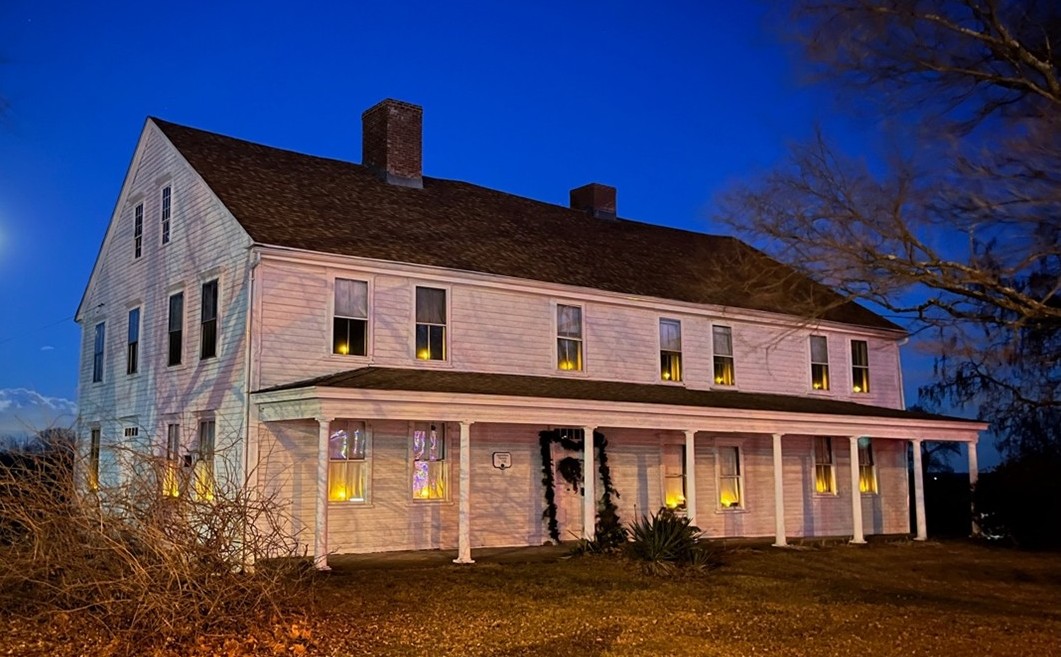
In the Hilltop Village of Mendon at 4 Main Street still sits a modest white clapboard colonial building located at what was once a thoroughfare of horse, wagon and stagecoach travel from New York to Hartford to Boston as well as Worcester to Providence.
The Ammidon Tavern captures our attention not for its ornamentation, decorum or stately appearance but for its sturdy and quiet presence in this once busy center for agriculture and pastoral land.
Built c.1745 by Ichabod Ammidon, the tavern served weary and worn travelers seeking rest and a hot meal along the way to their destinations. The story of this tavern however goes far deeper into the history of this country and the stirrings of a revolution. If these walls could talk, they would tell us of conflict and resolution, determination and commitment, patriotism and valor.

Ichabod Ammidon began operating an inn at Ammidon Tavern in 1745 as it was a stopover for travelers along Middle Post Road. A stagecoach journey from New York to Boston over this bumpy, dusty road was long and uncomfortable. The Mendon inn was a place where passengers could get a good night’s sleep and a hot meal. People could relax, socialize, share news and mail letters. They could purchase items in the village shops before continuing on with their journey.
At this time, taverns weren’t just a raucous place to get a drink — they were nerve centers for news, politics, militia musters and Committees of Correspondence, a crucial network of communication among American colonists to share information and coordinate actions against unjust British policies.
Ichabod Ammidon’s son, Philip, helped to run the tavern in the 1770’s. He was also a colonel in Mendon’s militia. One of the town’s training grounds was across the street from the tavern on land that we now call Founders’ Park. During the Revolutionary War, several military units of the Continental Army stopped there for meals and a resting place from marching.
On April 19, 1775, in response to the alarm of Lexington and Concord, 164 Mendon minutemen gathered here and assembled across the street before marching on to Boston. After the brutal Battle of Bunker Hill (Breeds Hill), British soldiers burned most of the buildings of Charlestown to the ground, leaving many people with no place to live. In June, 1775, 30 homeless patriotic refugees were provided a temporary place to live in Mendon and at this tavern until a more permanent living accommodation was provided back in Charlestown.
Ammidon Tavern and the Revolution
Although we do not know the exact words spoken, we can imagine based on the actions and records of the inhabitants of Mendon that they possessed a strong and patriotic resolve to remedy the problems imposed on them by the Crown. As early as 1767, residents voted to boycott products from Britain that were taxed without their representation. Strong leadership would arise in this farming community of Mendon through the words of men like Esq. Joseph Dorr Jr. and Edward Rawson who would later be appointed to the Committee of Correspondence.
Historical Mishap George Washington did not sleep here
Legend has it that the most talked about visitor to accept an invitation to the Ammidon Tavern was George Washington in 1789. Phillip Ammidon who served as a colonel in the Revolutionary War was an old Army friend of George Washington. Whatever mishaps occurred on that day it is believed Phillip went to run errands and neglected to tell the maid to invite Mr. Washington in. Instead, she turned them away leaving Mr. Washington to seek other accommodations in Uxbridge. The night was cold and rainy and upon learning of the error, Phillip and his daughter rode by horseback to try and retrieve his notable guest but were not successful. They enjoyed a visit together at the Taft Tavern in Uxbridge.
Nathan Hale
On Jan. 26, 1776 on his march from Connecticut to join his regiment in Boston, a young Nathan Hale, along with 11 recruits, records in his diary that they stopped at Ammidon’s Mendon and breakfasted. Son of a Connecticut farmer, Nathan graduated from Yale in 1773 with high honors. After spending time as a teacher Nathan joined forces with the Connecticut Militia in 1775. He volunteered to act as a spy for Washington and positioned himself in Manhattan behind enemy lines. Believed to have been recognized by a loyalist Nathan was captured by the British and hanged on September 22, 1776 at the age of 21.
Hale shared a dignified speech that summarized his regret that he had only one life to lose for his country.
Other Visitors
Beyond its daily travelers, the Tavern was visited frequently during the French and Indian War. Town records on July 26, 1758 note that Ichabod Ammidon agreed to serve 43 meals to soldiers returning back to Lake George. The orders were issued by his Honour, Governor of Massachusetts Bay Colony Thomas Hutchinson. Housing and feeding active participants of this and the Revolutionary War brought news and insight to the inhabitants of this village that most communities were not able to take in first hand. We can only imagine that this connection may have given Mendon settlers a deeper knowledge and understanding of the conflicts that lay ahead.
This article was written by Mendon historians Richard Grady and John Trainor and edited for this publication by Rich and Kathy Schofield and Anne Mazar.